Monday, January 31, 2011

Literature and Professional Value Systems


On Friday 21st of January, Larry Buxbaum, Executive Director of the Hennepin County Bar Association, the largest of Minnesota's twenty-one district bar associations, opened his convocation speech by emphasizing the use of literature to teach values and ethics to professionals in a variety of fields. He stated how the idea of using literature and applying it to professionals has been done as a technique to illustrate values and ethical points, and that it engaged a larger portion of the population, because now non-professionals such as non-lawyer administrative assistants working with the professionals, are able to tell them to get off the ethical high-horse because they do not have monopoly of ethics and values. Buxbaum elaborated by emphasizing two types of literature what one reads, such as plays and poetry, and ones own life experience and stating that the latter allows anyone, regardless of their profession, to examine ethical issues.

He exhorted the audience to carefully examine their rich personal experiences and the value they bring to discussions of ethics. He stressed that using literature does not mean that this is literary criticism we dont need to debate what the author intended to say with every word, but instead highlighted the participatory element; that small groups examining professional literature facilitated the merging of personal experiences, which effectively highlighted ethical values. He referred to the Swedish play The Visit and how it illustrated that concepts of power, justice, and public and group behavior are all very much entwined, allowing its readers to see that our society has been guided by group hysteria and responses. Buxbaum asked whether ethics were constants, or whether they changed over time.

He noted that sometimes professionals are mistaken in thinking that they have a certain monopoly on knowledge of ethics and beliefs, and that this was a pre-sumptuous mentality. He reinforced his notion of the importance of the personal experience, and mentioned how this tied in with the crucial nature of context. This included cultural and temporal context, and he evoked scenes from Baldwin's short-story Sonny's Blues which illustrated how much of its dynamic was a function of context and its effects. In addition, he mentioned Miller's The Crucible and its allegorical reference to McCarthyism, further emphasizing the essential role of context. This segued into the assertion that we sometimes assume that our leaders are ethical just because they are our leaders, and how this proved to be largely incorrect. He thus emphasized that since we know our leaders will be setting the tone for those they lead, we should examine the essence between ethical behavior and leadership, and how to combine them.

Buxbaum concluded that not a day goes by where we don't have a new experience, which leads to introspection and forces us to re-evaluate what we mean by ethical behavior. Through closer examination and teachings of important ethic values illustrated in literature, he hoped this would allow us to grow as leaders, students, and citizens of the world.

Monday, January 17, 2011

Visions of the Gamepocalypse


By default, we clapped for him politely as he approached the lectern. But instead of allowing it to die down, Jesse Schell - CEO of Schell Games and author of the award-winning book The Art of Game Design - motioned for the audience to continue in a steady beat. As the rhythm filled the chapel where guest speakers to the college always spoke, he whipped out a harmonica. And blasted away vivaciously, with closed eyes and tapping feet, shoulders bobbing to the music. This young man was an Assistant Professor at Carnegie Mellon University. He knew we were undergrads; after such a fiery introduction, we knew he knew how to keep us engaged. The audience, though large and enthusiastic, wasn't pushing the limits of a full-house. Indeed I knew many classmates and peers who had heard of this talk by a 'game-designer', but were discouraged to attend by assuming that it was far too technical and esoteric for the average liberal arts student. I had heard of his game-design book once before; had not personally read it, but knew that it wasn't some overly-intellectual, inaccessible realm. And neither was his talk.


Schell opened by discussing how the program he taught at Carnegie Mellon University's Electronic Game Center - which features the slogan "The Graduate program for the Left and Right Brain" - thrived by “bringing together different disciplines to teach them how to be on creative teams.” By emphasizing this need to be interdisciplinary, he commented on such a growing trend in the contemporary world of technology; that the development of the iPhone required both engineers and artists, because with a team of “just engineers it would be too technical and not pretty, but without artists it would only be pretty and not technical enough.” Schell then linked with another “growing trend that has gotten a lot of attention recently,” which was that consumers were increasingly demanding authenticity in their products. He referred to the recent book Authenticity: What Consumers Really Want by Gilmore and Pine II and highlighted that now “as a society we’ve become so technical, that we hunger for something real.”


Schell pointed to the recent explosion of “social games”, commenting on how video games were “reaching out to reality” with systems of virtual achievements for players to obtain and measure progress. He then highlighted a similar pattern in reality; that “game structures” in the form of accumulating points and progress were rapidly appearing in the real world – from credit cards to Starbucks. In arguing that it has become “increasingly difficult to disentangle reality with games”, Schell wondered about the point in time when these two were inseparable. He painted the picture of a scenario that admittedly was not entirely hypothetical: waking up to video game advertisements of big companies; pervasive product placement on toothbrushes and cereal boxes in the form of games; an intricate world where everyone had personalized accounts that stored points and accumulated high-scores from games, which fed back to the consumer by offering rewards and discounts and more promotions. Constant internet - and by association, Facebook - connection was the status quo. More importantly, everything one did - high-scores, new records, increased average point score - appeared on everyone else's live feed. In essence, a lifestyle so ingrained with technology and social networks that everything would be monitored and saved – a livelihood Schell argued could be taken as “either a disgusting nightmare”, or could “encourage us to become better human people”. The former is obvious; constant intrusion of privacy and rights (although today one could ask exactly how much the public is concerned with this, considering Mr. Zuckerberg is the 2010 TIME person of the year...), a Orwellian evocation of surveillance and paranoia. For the latter, Schell purports that there is wiggle-room for the individual - in light of everyone knowing what book he/she reads, what movies he/she watches, what he/she just ate - to improve their lives. In the age of heightened self-consciousness, one would care even more how they appear before the world - especially online. So one might choose McCarthy over Meyer - on the Kindle of course - to impress the circle of literary friends; might choose to watch Bergman instead of Bay (because one can only take so many sophisticated explosions and wailing Decepticons) to satisfy the celluloid junkie buddies.


There is something inherently irresistible about video games. Schell explained this mass appeal; how “they give us clear feedback” alongside “a sense of progress”; how they provide “mental and physical exercise” with “something to satisfy our curiosity”, and of course the possibility of success and the sense of freedom. He then referred to the concept known as the Singularity, describing it as the extent one can accurately predict future trends and events. But with technology becoming more and more pervasive, this window of time is rapidly closing, and that soon “we will reach the Singularity when one will not even be able to predict what will occur within five seconds from now.” Schell discussed how this would inevitably lead many to become "future-blind”, but because the world was changing so quickly, and one could conjecture and fail and then conjecture again, there would also be room to actually practice this art of prediction.


Regarding the ‘Gamepocalypse’ – the scenario mentioned earlier where everything one did was monitored and uploaded to the Internet – Schell described this road as “long a twisted, with many things along the way.” He discussed these at length, such as the role of “microtransactions” and the unprecedented success of Apple’s app store and its one billion downloads, which he argued would change the way big game companies and their conventional, console-based products, would operate in the future. With regards to big names like Playstation and XBOX and the Wii, Schell discussed the sudden emergence of social game networks such as Zynga and Playfish, which he argues present a huge threat to the conventional idea of the game console. With online socializing taking the nation by such a storm, people are much more willing to forgo visual depth and plot of console games - not to mention the cost of paying $30-50 for one - and instead join a Farmville or Mafia Wars fiasco with multiple friends on Facebook for free. And Schell recognized the strain this attitude put onto the big game companies; many were unwilling to be the first to set up to the plate and invest in this new area. But some have already gone there: EA Games (Electronic Arts) laid off 1500 employees to buy Playfish Games for $400 million. Microtransactions are becoming a much more prominent factor in the modern game design industry.


As mentioned earlier, Schell claimed that the road towards the Gamepocalypse was long and complicated. He wasn't going to predict when it would come about. But he was taking note of new factors and aspects springing up along the way. With increased customization, sharing capabilities, geo-tracking and more, games were being rapidly integrated into our daily lives. But regardless of whether it leads to a waking nightmare or a prompt for comprehensive re-evaluation of our lives, Schell believed it “all has to do with people creating things.” Creation using new technologies to achieve particular ends, and having those ends determine what times of people we really were. Artists who create for the sake of the aesthetic? Humanitarians who create to improve the lives of others? Profiteers who create to deepen their pockets? As we become propelled into the twenty-first century and beyond, Schell placed increased emphasis upon that very motivation to create, because when we finally reach the Gamepocalypse, the very stuff of that reality depends on what we want and are willing to do with that new world. And no, it won't be based on how many friends you have on Facebook.

Tuesday, June 29, 2010

A Spiritual Oasis

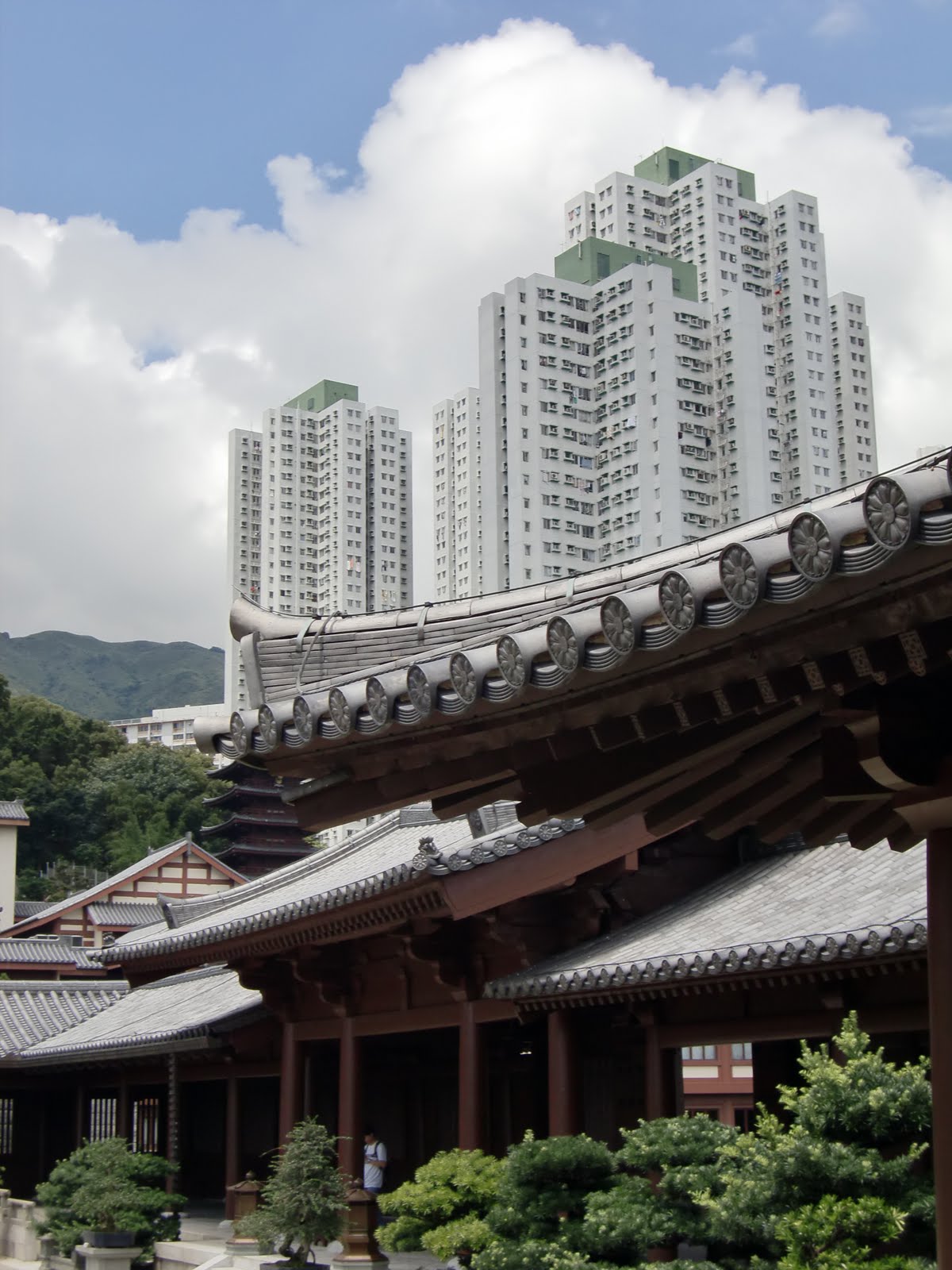
One would have never thought that amidst the dizzying maze of overhead bridges and perambulating roads, an oriental garden of seemingly untouched tranquility lies virtually disconnected from its urban surroundings. Scores of traffic whiz by each hour tooting their horns and blaring their mechanized modernity with pride, but step inside Nan Lian Garden (南蓮園池) in Diamond Hill, Hong Kong, and will find themselves strangely separated from the bustling metropolis that envelops this oasis of calm, for little more than the occasional soft hum of engines can pierce its verdant interior.

An eye-catching welcome amongst a sea of green right at the entrance of the park

A brilliant range of colors flawlessly combine together
in contribution to the park's peaceful vibe

Straightaway one notices the architecture of the buildings inside the garden. Adopting characteristics from the Tang Dynasty ((618-907 AD), these wooden structures are perfectly integrated amongst streams flowing over dark glossy rock surfaces and underneath brightly colored bridges, lazy lotus ponds, and rows of delicately maintained bonsai trees. Not a single nail was used in the construction of this 35,000 square meter park, illustrating the harmony with nature and spiritual consciousness that the architects embraced. Gentle waves of inner peace are contagious to tourists and local residents alike as they all enter this beautiful park zoned off from the frantic schedules and rushing crowds that the rest of the city entails. Add emphasis to the numerous Buddhist figures neatly tucked away behind the haze of incense and praying cushions - all protected in their divine state by numerous signs prohibiting photography and video recording - and one cannot help but feel a meditative bliss immediately fall over their senses, soothing us from the hustle and bustle that is at all times just an arm's length away.


Steps into the temple that occupies the central component of the park


Multiple layers of traditional Chinese architecture (Tang Dynasty characteristics) result in an effortless integration with its mountainous background

Rows of exotic trees and plants alongside buildings that house souvenirs

Although audibly isolated from its urban surroundings, the ubiquitous city buildings nonetheless add a unique visual flavor to the park. High-rise apartment buildings that extend out of shopping mall complexes are a typical feature of many residential areas in Hong Kong, and Diamond Hill is no exception. Many a snapshot taken from inside the park will undoubtedly find a grey structure or two lurking in the background, but by no means are these seen as intruders. Rather, any urban presence is ultimately indicative of the city's ability to effectively maintain the existence of both traditional and modern aspects of life with minimal compromise. The deep spiritual, religious, and meditative nature of Nan Lian Garden is held in even higher regard and reverence amongst visitors, all of whom are undoubtedly relieved to find a reprieve in this peaceful realm. Within a city that never sleeps, locations like this really serve as a refreshing haven for many whom too frequently find their lives deeply steeped within an urban monotony, and with increasingly conscious attitudes towards environmental and cultural preservation, more such parks would ultimately be very warmly received by the populace.

Skimming the temple rooftops are the towering bodies of nearby residential estates.


In all of its entirety, the spiritual essence of the Buddhist figures are neatly encased amongst an urban mindset that is still very respectful towards the traditional and the religious.

Tuesday, March 16, 2010

It's Time

"As if you could kill time without injuring eternity." ~Henry David Thoreau, "Economy," Walden, 1854

Time is a magazine, a Pink Floyd track off The Dark Side Of The Moon, and what can manipulated to extreme ends in countless bouts of science fiction. It's also what the clock face shows, a phrase taken straight from Albert Einstein's own mouth, showing that even one of the most influential and influential scientists of mankind could offer no scientific qualms concerning time, but instead conceded in revealing a basic, obvious observation - that he was as knowledgeable as the next man in having a one-liner about time.

I remember reading W.H. Auden's poem Stop All The Clocks back in eighth grade. It was for a literature class, and by all means I hadn't really stopped to ask myself the implication of what he was describing, but rather persisted in trying to wrestle my brain around grappling the identification of similes and metaphorical value in order to inject substance onto paper, hoping for a good grade. I think it advances my point to say that the essay didn't do so hot either, considering I was trying too hard to stand out as superior to my classmates, and clumsily commanded what I thought at the time was verbal dexterity, when indeed my fourteen year old bold comments and flashy generalizations about time were not at all as grand as I had initially envisioned. But the image the poet offers for us as food for thought is something for us to chew on for eternity. Stopping time, even for mere moments, would definitely have implications too profound to grapple with in a teenager's blog.

That isn't to say it hasn't been thrown around before, and indeed by the very same teenager. Late nights at the college library have most certainly involved me counting down the remaining number of hours I have for sleep until my alarm clock stirs me from blissful abandon. My roommate and I have discussed the possibility of technology advancing to where each human is able to crawl into a realm that is timeless - a domain that can only be used for sleep and recuperation. So no sneaking off with incomplete work assignments safely concealed within underpants - a nasty little Christmas present for just about anyone - but indeed just a safe haven to ensure that we can carry on producing and functioning like the workaholics we are after great, interminable lengths of sleep. Of course it's never going to happen - but the implications for us were nonetheless distractingly dreamy.

Then again, the idea of hyper-advanced technology bearing the fruits of incontrovertible benefits and creating the ultimate utopia have been questioned before, particularly with Brave New World. Huxley has shown us the devotion that people of London in 2540 exhibit for technology, as it has been taken up with religious fervor, most obviously seen in the absolute integration of the phrase 'Ford' into human life, such as the exclamation "Oh Ford!" to indications of time with A.F. instead of A.D. So unfortunately for us college students, perhaps hoping that technology advancing to such a level may push the bliss of infinite sleep to becoming insignificant in the larger scale - that is, the futurism offered by Huxley in the form of sleep-learning will become an utter reality.

And with that it's indeed time to hit the sack. Before I go, here's a product of inspiration resulting from recently breaking my alarm clock early in the morning as I emerged from a murky world of dreams. Enjoy~

Alarmed

This morning, whilst flailing around within my dreams,
I struck out and destroyed an alarm clock; shattered machine.
There lay time broken with its cell detached and cold;
The hands paused and went dormant; having dreams of its own?
Clumsily, I attempted restoration; the cell returned to its position,
- Gracious power returned to the ageless entity -
But lightning struck twice, and again it dropped to the floor,
Releasing cataclysm and a fractured glass pane.
Within this I saw a crack ripple through its frame;
- For a moment, there was a crack in time itself -
And amidst this I realized that time had momentarily froze;
Merely a fraction before other clocks continued their death drum.
And I wondered if one continued to destroy clocks for eternity;
- With endless abandon and continuing the carnage forever -
Would these fractions accumulate to something more substantial?
And that we could actually stop time in its tracks?

Tuesday, May 12, 2009

A Patch Of Corn - A Year On From Ground Zero

The woman was most certainly in her late forties, face darkened with years working in the sun-laden fields, hands callous with the damage of demanding physical labor. She gestured towards a small small, solitary patch of corn stalks standing in a quiet corner of her farm fields. Although the heavy grey clouds overhead hide the sunlight, the stifling summer air can easily mean dehydration for anyone working in the unforgiving farmland.

The woman is asked about the corn stalks, for they seem an anomaly amidst the rows of rice terraces that make up the majority of her family's agricultural income. Her eyes glint as she answers - the corn is grown on the very patch of land that her older sister and sixteen year-old son are buried under.

About four hours later, ten miles away in the town of YingXiu, a great white slab lies upon steps of crimson red carpet. It is a memorial site; a giant analogue clock face with thin fissures serving as clockhands, marking a ghostly hour of death at two twenty-eight in the afternoon. The sight steps on the accelerator for memories a year earlier; at the time the entire region was shuddering in a devastating earthquake of 8.0 magnitude, shaking apart the land and shattering hundreds of communities and thousands of lives, while drawing the eye of international attention immediately. Today, however, the site is silent. Chinese President Hu Jintao alongside other members of his cabinent is bowed in a deep, quiet minute, whilst a squadron of soldiers handle large vases of flowers and arranging them before the memorial.

The president and the rest of the political figures of authority proceed to pay their respects to the victims that reaches a staggering figure of approximately ninety-thousand. Each person in the line lays down a single white chrysanthemum flower before the giant white clockface, whilst giving their attention in the form of silence to the dead.

It was such a solemn event that captured the intense despair and tragedy of the calamity a year earlier. It was the worst to afflict China in thirty years, and with so many of the deaths being students and young children didn't provide a modicum of salvation for anyone. There has been a constant battle between parents who have been left childless; wives who have been left widows; husbands who have been left alone, against those responsible for the shabby construction of schools in the area. But with the collective opposition of government hush money, or intimidation to keep quiet has prevented much of their unquenced torment and anger from being expressed. Even now some still have doubts over the real figures of student and children deaths and numbers missing are truly accurate; some get the feeling the government is avoiding confrontations with those allegedly responsible, because such claims may only be riding upon interminable sadness and rage, and that such pursuits would ultimately use up much of the resources provided by such generous dontations from around the world.

The suicide rates of survivors have been clear indicators of the true trauma. Soldiers of the Communist Party that spent entire weeks after the earthquake carrying survivors over the trecherous, improvised mountainpaths to safety ended up losing their own children and loved ones back in another region, and have found the grief simply too much to bear. They have lost any type of memorabilia in the earthquake debris; the only thing that remains is a passport photo they carry in their wallets, or the final colored drawing done by the child before they were claimed by the earth. Others strip their walls of any reminders of the family they once had; picture frames are turned over and hidden, whilst photos are wrapped and stashed away - out of sight.

The earthquake does what all natural hazards do; they demonstrate the true fragility of human life amidst the progressing events of Mother Nature. It expresses with frightening clarity just how transience our existence is on the planet; that in the bigger picture of plate tectonics and physical geographical processes our established settlements are trivial and superficial. The despair that shocked us has never been so raw and devastating before, and even with life beginning to move on in a compulsory direction if it must rise and progress, SiChuan and the rest of China is still feeling the tremors of the May 12th 2008 earthquake, because hearts and souls are still shaken by its tremendous power.

Crouching low on her knees before the nearest corn stalk, the woman gently ran her palm along its thick stem. Her brown lips cracked a thin smile; she grips herself to not feel despair or sadness any longer, because this cornstalk represents what she hopes to soon embrace: that out of the disaster and tragedy, the small and new seeds of life can break from the trauma and begin to grow and thrive once more.

Saturday, January 3, 2009

Waltzing with the Great

I was digging through some old movies in my cabinet and came across The Great Waltz, which was originally filmed in 1938. For the next hour and forty minutes I was charmed by its classical masterpieces that were both enormously powerful and stunningly graceful, created by composer Johann Strauss II. Some, such as The Blue Danube, were strikingly familiar, and contained enough energy to fill a palace. Others were softer and more graceful, but still got my foot tapping to the beat as I watched the characters waltz enthusiastically in the black and white motion picture.

In particular I felt very moved by watching the autobiography, especially with the artistic inspiration and sympathy that I received. Johann Strauss II was a musical protege from the start of the movie, portrayed as one who could not leave his passion as he secretly scrawled music scores whilst working as a banker. When he is fired for slacking on the job, I felt reminded so that there was a great difficulty to become financially stable when living as an artist. Later in the movie when he first becomes successful and signs a contract to a member of the Imperial Palace, thus agreeing to hand over every piece of completed music he writes, I feel that he had attached himself to something that perhaps did not fully appreciate his abilities - for personally I felt that no amount of money could substitute or be exchanged for his composition. When he becomes married and thus very financially comfortable, there is a sudden sense of anxiety and bitterness, for I felt that he was caught between two different worlds and decisions. Despite having everything he could have possibly wanted materialistically - money, fame in Vienna, and wife - the only way he could continue to further pursue his musical passion was to give even more of himself to the Imperial Palace.

The matters were complicated when the opera soprano Carla Donner seems to be the only one who really appreciates his ability for writing such brilliant waltz pieces. Yet she is a member of the Imperial Palace, and thus visibly puts pressure onto the marriage between Strauss and his wife with her love for his music. The beginnings of an affair between her and Strauss came across to me as even more tragic because for Strauss, he could only take his zest for music further by being with a woman such as Carla, who understood his passion more than his wife. Strauss realized that although he was socially and financially happy, spiritually he was not because his own passion could not progress unless he hurt someone important in his life.

I felt a strong pull towards the portrayal of the young artist in The Great Waltz. There was the brooding atmosphere of trouble when Strauss is pulled into an affair with Carla, and for me there was even more pain because I saw his music could only progress by moving past what he currently had. When his own wife was so devoted to his welfare and happiness, Strauss still could not afford to lose his grip upon his passion, and here the tug of war began erupting even further. What compounded the problem was his integration and interaction with the rich: the close friends of Strauss particularly did not prefer the rich, and this is peaked with the revolution that occurs later in the movie. Here Strauss puts even his own social bonds and connections at risk here for the pursuit of his passion and love, and I found myself looking at the plight of an artist as he faced such pressures and restrictions. I always saw it as too unfortunate when one delved too much into the arts that they neglected their family and loved ones, but after viewing The Great Waltz I saw it as almost inevitable - or at the very least very likely to happen. And with that I found myself wondering if I would have to deal with such a frightening dilemma if I were to pour myself into an artistic passion. Would there still be room for anyone or anything else in my life? Or would my only love be what I was creating?

Friday, January 2, 2009

The Calligrapher

He was a man no older than forty. His serious face became even more stern as his brow furrowed with concentration. Instead of brush writing on a table or platform, he used the jagged concrete street surface.

The skill of his East Asian calligraphy was unquestionable. The thing that drew the crowd around him was his lack of something we all take for granted: his two hands.

It was four in the afternoon in one of the busiest locations in Hong Kong: the sprawling district of Mong Kok. With the nearly interminable Nathan Road that runs through it, traffic can stream through here all day long. Add that to the magnitude of pedestrian shoppers that filter through its alleys and sideways, and it's just chaos all very local to Hong Kong. Today I had just finished a periodic visit to my dentist, and as I began heading back towards the Mass Transit Railway (MTR) station through a road that mainly sold electronics, I noticed a line of people all motionless in the middle of the street.

I slowed and moved over to join the line, which soon began to elongate into a gathering throng of people twenty-strong. It was a young man alone on the street, with great big sheets of thin paper called
XuanZhi 宣紙 paper laid out on the rough concrete before him. On the ground beside where he crouched were a couple of dirty Bonaqua water bottles, a cracked inkstone, and a small circular seal paste plate. Between the dry blackened remaining stubs of his arms clasped a battered and decrepit paintbrush.


My chest tightened as I saw a small pouch lying near the set of phrases he was currently working on. He was begging for money - a few pieces of change that the enthusiastic shoppers of the bustling electronics and hardware stores around him may want to get rid of. He continued writing without pause, at times using his teeth to straighten and realign the thick paintbrush that sat neatly in between his two arms, which were severed at the wrist. I felt myself wondering what tragedy could have befallen this unfortunate man. Could it have been a deformity from birth? Had he suffered a devastating burn or injury that resulted in amputation? Was it a devastating accident that he experienced during his previous job as a carpenter or blacksmith, which could've been very well-paying? I felt these questions bombard me as I continued to silently eye the painting calligrapher, who let the brush dance elegantly under his control. One would have needed the practice for several years to achieve the standard he was producing before my eyes at that moment. And even so it would be with all ten fingers and a very dexterous wrist: I couldn't let myself imagine what sort of hardship this man experienced without the prehensile hands we took for granted. Had he been this skillful before he had lost the lower halves of his arms? Or had he been forced to adapt a different way of calligraphy due to his physical ability - and still managed to create something so artistically masterful?

The phrases he wrote were all ancient Chinese sayings: ways of the word spoken by philosophers and scholars and emperors alike. They embodied a very traditional aspect: four characters per line, which could have vast symbolic meanings. Between his focused and delicate strokes observers moved forwards to drop a few coins into the small pouch that openly displayed its empty interior to the crowd. The clinking of metal upon metal triggered the man to look up from his work and nod at the generous act, as he crinkled his haggard face into a sad smile, and verbally expressed his thanks out loud before continuing with his writing.

It took no longer than five minutes before he gently laid the brush down onto the inkstone, wiping his forehead with what remained of his forearm. He then hopped backwards and used his feet to slowly nudge the seal paste plate forward, where he then hoisted the metal container to his mouth and pried open the cap using his teeth. The bright red paste was used to imprint his name onto the completed work as a sign of his own craftsmanship and creation, serving as the artist's signature upon his piece of brushwriting. The seal itself was made of gray stone - no longer than a finger - and the calligrapher fumbled with it for sometime before he finally managed to dip it into the sticky paste and stamp it onto the sheet. A nearby onlooker knelt down to inspect the writing more closely, before nodding and dropping a couple of money notes into the small pouch before rolling up the paper and carrying it off with him.


Beside the calligrapher were a couple of already completed sheets, held down at the corners by the empty seal box and some half-filled water bottles. The wind ruffled the edges and began lifting the bottom of the sheet, but it was very legible to onlookers as they crowded round to admire his work and at the same time feel a stinging in their hearts at his downtrodden condition. One of the Chinese proverbs I found the most meaningful was this one:

(The proverb is read from right to left:自強不息)

Translated, its meaning referred to the mindset of constantly standing strong for yourself and no one else. It emphasized self-improvement and self-governance: the strength of willpower for the individual only. This struck me has incredible apt, because here we had the calligrapher fending entirely for himself on the streets of Mong Kok. His physical disability could have always had the potential to faze his artistic talent and abilities, but instead of allowing that to heavily affect him he fought onwards. Even without individual fingers to guide his brush and a palm to steady his strokes, the calligrapher amazed every onlooker with his poise, accuracy, and grace. The elegance of his work was unquestionable: and here the very proverb he was writing out to sell to other people was an ancient philosophy that he was still living by in today's ruthless modern world. The strength of his own willpower was incredible, and that afternoon I felt myself feel inspired by this calligrapher, knowing it meant even more so that things we take for granted should instead be appreciated to an even greater extent.

The entrance into the year of 2009 probably hit the world in showers of sparkling lights, excitement, and exploding fireworks. People of Hong Kong were rushing out to get their hands onto great deals in the stores on the street as monetary issues become more and more difficult to handle. But amidst such energy, this calligrapher was a reminder of how the strength of an individual truly should not be underestimated - and more importantly one thing we cannot take for granted either.

Tuesday, November 11, 2008

Ashes of the Wake

Shrieking vocals, galloping guitars and high-speed drums fly out of speakers when this CD plays. Nine out of the eleven tracks on the album will kick off with a steady explosion of heavily distorted instruments, all storming out with incredible rage, power, and ferocity. Those new or unfamiliar with the genre of metal will contort their faces in disgust, protesting that this was a shame to the name of music. So why do so many turn their heads away? If the audible sounds are too disconcerting for the average ear, many people drown out the lyrics or possible themes because of the assumption that it's "too loud" or "too messy" to have meaning. And that, ladies and gents, is completely off the charts.

Many a review focus upon the music content and technicality of the album, accessing it from a musical rather than a thematic and symbolic perspective. Don't get me wrong; I certainly dig those reviews and articles about albums, but in particular this one can be a real shame to overlook, particularly when it is one of Lamb of God's most motivational. The album centrally aims at the 2003 invasion of Iraq. Songs that prominently highlight this theme are "Now You've Got Something To Die For", "The Faded Line", "Laid To Rest", and the album-titled song "Ashes Of The Wake". In a quick overview, the lyrics contained on all the songs involve the persona directing negative emotions - betrayal, hate, rage, and frustration - towards entities that represent efforts of the war. It is even more interesting to see that out of all the songs on CD, the album-titled track is the only one that does not contain any lyrics. This is interesting to note because there the presence of two guest guitarists formerly from other heavy metal bands Megadeth and Testament adds to the intensity of the music, thus almost pushing away and eliminating the need for words.

The first track of the album "Laid To Rest" contains the words "The blood's on the wall, so you might just well admit it". This seems directed towards the US government that not only instigated the war, but claimed that the violation of UN policies and global image of powerful Western influence mercilessly invading a lesser country was completely justified. The lyrics assert that contrary to administrative claims, the damage has been inevitably caused, and it is more brutal and ruthless than was ever initially regarded. The more political motives of this album is evident via examination of the frequent repetition of expletives contained in the latter part of this track. "See who gives a f----!" is heard between intervals of slow and controlled sequences of unvaried low notes on the guitar. This "breakdown" technique effectively instills a strong collective atmosphere of rage and motion that peaks during this point of the song - reflective of the strong protest towards the war. The sheer ferocity of this track rips out through the air and postulates the pure incredulity of the 2003 invasion.

The second track on the album is named "Hourglass". We are taken back in time to a series of wartime invasions here, and certainly the concept of time is a common motif throughout. The burning of draft letters - hence resistance to conscription - is evident in the lyrics "the edge of the envelope burns". The imagery of clashing gods with their insurmountable wrath and vengeance is clear in this track, outlining the ineffective and certainly overly-ambitious US government tendency to "Play God" with their peacekeeping strategies and hence seek out and destroy all forms of tyranny and abuse in today's world. The only thing left is death, and in particular we are overwhelmed with the hand of the devil from the reference to the Jewish gate to the underworld in "Gehenna has now arrived". Additionally the persona mocks upon the foolishness of those who fought for the name of their country amidst this completely unjustified invasion: "You finally made it home, draped in that flag you fell for." It connotes to foolish and naive martyrdom; a needless and unnecessary death in the name of something completely ill-fated and inhuman - all for political authority.

"Now You've Got Something To Die For" is another song written to draw attention to the foolish efforts of the war. This track seems more like a vision cast into the darkest possible result and consequence of the war, for it is metaphorically titled as a "prophecy", and it is "fulfilled" with actions of hatred, destruction, and utter chaos. The American solider is characterized as a determined bloodthirsty monster that does not stop the search for killings or murder. This is evident in the words "Lust for blood, a blind crusade", pertaining to the foolishness of the invasion, especially since the only real reason seems to be for the pure pleasure of the kill. There is very strong and violent imagery conjured, such as "raping democracy"; a sign of pure failure upon the American government with plans to enter Iraq and emerge victorious, but instead have shamelessly ruined the result they sought to accomplish.

There is a sense of entering the mindset of the fighting U.S. marine in the next track "The Faded Line." Here the lyrics are almost of a 'stream-of-consciousness' manner; the frequent high-pitched shrieks that utter the bleak adjectives "hopeless...emptiness...colorless" are like desperate cries for help and salvation. This is a catalyst to the psychological breakdown of the solider; the fact that he may be coming to terms with his crimes of war that he has no choice but to continue undertaking, because they are the orders of his high-command. The "promise" mentioned in this track is almost a reference to the original aims and intentions of the U.S. government; to establish a democratic office within the country of Iraq in order to rid it of tyranny and exploitation. Yet these plans have more than just backfired; we can see that it is now just a "silence" and hence a definite shadow of the former promise it once was.

A common definition for the next track "Omerta" is a code of silence. This term stemmed from areas such as Sicily or Campania, where organizations such as the Mafia reigned powerfully. It extends down to those who serve them; in that if they are convicted of a crime, they will remain silent and will not protest to provide any further information, even if they are falsely accused. Thus, this was used to prevent the leaking of information about more powerful figures within the organization, giving them confidence that lessers within the party will take the blame for them and allow them walk unblamed. This track of the Lamb of God album is the slowest pace, but provides definite power and force. The spoken introduction by vocalist Randy Blythe serves to add a sinister beginning to the song, highlighting the importance of the honor code within fighters. It underlines the procedure of those subject themselves to falling obedient to the code of silence, and illustrates them to end up twisted and a shadow of their former selves. The slower part of the song highlights the mind of the organization in power, offering a certain comfort to one who is yet to be recruited. The pounding of the instruments - a slow, yet brutal rhythmic pulse - is an indoctrination that drums into the mind of the recruit, making sure he is capable of serving. Then as the track rips into a faster pace, higher-energy section, we have the solider faced with the enormity of his actions; the fact that his fate is now tied with the silence of his mouth, and if he speaks foolishly, his life will go with it. The mistake of "a slip of the tongue" will only result in death, which is evident in "a slit of the throat". Furthermore the lyrics "Keep my name from your mouth forever" pertains to the mastermind of the organization kept secret, and the fact that the song concludes with "Sing for me now" suggests that there will always be new recruits that are willing to offer themselves up...always new recruits ready to die for the crimes of someone wielding them as pawns.

The chunky guitar riffs and irregular drum patterns in "Blood Of The Scribe" reflect the sudden realization of the solider in battle. He realizes that there is imminent death within serving to fight this war, whether it be killed in action or surviving but becoming scarred by the results for life. We have him entering a delusion mindset; the insomnia in "sleepless" as well as loss of faith in "hopeless" serves to tie in with the connotations of graves and burial. His entrapment is evident in the lyrics "Climb the walls till nails bleed, rip the hair, tair the seems, break the glass", where the final vestiges of his composure are finally dissolving to provide very violent imagery of his breakdown. The vampire is a representation of the solider, for he is killing for blood and has no other purpose. Blythe's bloodcurdling scream "sun" reflects the marine's hunger for sunlight; a metaphor for salvation and liberation from such a hellish reality that he must remain in. Hence, the scribe is the general that reports back to the U.S. Army about the situation against the insurgents, but of course the blood he writes with comes from the solider.

The lyrics of "One Gun", the next track of the album, illustrate the intentions of those who live and die for their country. The characterization through the eyes of a sniper at the beginning of the song suggest a concealed but deadly threat that is always watching. The title "One Gun" refers to the mockery of the salute of honor to martyrs; the lyrics "a one gun salute for the new Independence Day" connotes to an outrageous act of dying for your nation and then being remembered on the country's national holiday. The prominent message of this track is the satirizing of how glorious sacrifice really is; on the surface it seems beyond honor that one should die in the name of their country - that one should sacrifice themselves for their nation. But through the eyes of the solider we see that it is a completely overrated concept; that sacrifice for the longevity of your country will prompt the government to do nothing better, and that your death will have only been in vain. The repetition of "They'll hallow your name" is almost ironic, because through this constant veneration of your name and how you are honored because you died in your country's name, it does not make a difference at all when the U.S. government will still proceed and see thousands others die without batting an eyelid.

Beginning with a thin moment of guitar instrumental before the vocals kick in, "Break You" is the shortest track of the album. The imagery conjured up is dynamic and violent: "cut by the dawn razor" ; "whipping the nightmares to a froth" all suggest brutal force of dehumanizing style. These violent lyrics seem directed towards the U.S. government, where "The empire of lies to whom you pandered" . This suggests that they seemed to have waned from their original intentions to cleanse Iraq of terrorism and fear, and have instead turned to killings and torture and interrogation that all ignored human rights and standards. Furthermore, the controversy behind their real intention to invade and hence control the oil stocks of the Middle Easy can also be reflected in the "pandered", thus illustrating their catering to lower tastes and hence exploiting the resources of the area. The hatred escalates in the words "You taught me hate, I'll teach you fear", where the lessons taught by the army are soon sought to be reversed, with the solider relaying his venom back onto his commanders who cannot see past their blind and foolish mission. This intensity peaks with the ferocious ending of the song "Son of a bitch, I'm going to rape you. Son of a bitch, I'm going to break you", conjuring up brutal images that are reflected in Blythe's chilling, bloodcurdling shrieks.

"What I've Become" is a track that underlines the sequence of events when the solider is viewed as a total stranger amongst familiar faces he once knew. The lyrics "Blank stares from broken men" serves as a grim reminder of the total monster he has become in the eyes of those who once knew him, for he has mutated into a killer in simple terms, obeying or disobeying his orders. The religious speakings "You giveth, I taketh away" suggest that there are meddling and defying with the intentions of God - that their actions of inhumanity and cruelty will earn them eternal punishment. The solider realizes that he is nothing more than a mere pawn in the grander scheme of things; the words "Take your place in the line to be ground by the gears of the masterpiece" serve to show that he is simply another piece of the puzzle; a mere number amidst the enormous equation to try and defeat terror in a staggering full-scale invasion. His death will therefore count as nothing; even as martyr he will achieve nothing, and the repetition of "betrayal" further stabs out accusations towards the U.S. government, further reinforcing the bitter feeling of isolation and abandonment he is experiencing.

The album-named track "Ashes of the Wake" is one that contains no lyrics, other than that of an alleged U.S. Marine who served in the army and fought in the Iraq war. The mechanical tone in which he first speaks characterizes the commands that were mostly given to him by his superior commanders in an empty and meaningless way. He mentions that the war had become "an eradication", thus pertaining to the way the war had deteriorated down to nothing but a carnage. In the same manner the U.S. invasion of Iraq reflected this attitude; indeed it was becoming another war in Vietnam once more. Only the numbers of killed terrorists mattered each day; the mission relied upon taking out potential enemies that - most of the time - where nothing more than innocent civilians. The track has a complex rhythm and choppy guitar riffs; an overview of the turbulence that the war would ultimately result in. Furthermore, the inclusion of solo guitarists from other metal bands - Chris Poland, former Megadeth guitarist and Alex Skolnick, former Testament guitarist - illustrates the full intensity of the war, for the fiery solos that erupt on this track are double the magnitude, and that means double the aggression.

Saturday, July 26, 2008

46 days

This video clip was created 46 days after the terrible tragedy that struck Si Chuan province on the 12th of May 2008. It is a tribute to those who have lost everything in this disaster - including their lives.

Greatly appreciated to those who watch this video. Because by devoting your time to this tribute, you show that you care for those unfortunate victims...and that is the least the rest of us can do.


Saturday, April 19, 2008

Decisions Lead To Change

"Things do not change; we change." - Henry David Thoreau, Walden

A frequent question that sails into mind is this: do we ourselves cause change in our lives by making certain decisions, or are we acted upon by events that happen around us?

I agree with the former; that we as people cause change in our lives by choices. Take a look at Chairman Mao's reign over modern China: the way he governed rule and the country demonstrates this point clearly. His incredible feat of lifting China out of its backwater state of warlord rule and Western oppression owed greatly to the certain decisions that he made within his leadership. The choice to initiate The Long March in 1934-35 as GMD troops closed in on his Communist forces saved the entire political party from complete death and demise. He had been met with strong disagreement from his prior to such a decision, whom postulated that this giant retreat was outrageously cowardly and certainly not the best decision to make. Yet Mao did not allow his tenacity to abate, and pursued to carry out The Long March to save his comrades. We can therefore see that it was his decision that changed lives; we can clearly acknowledge Mao with the credit of a hero through the choice that he made.

Decades later, his choice to initiate the Cultural Revolution threw the whole country into complete chaos. His current motives at the time were to purge his political opponents, yet the chaos that followed was not catalyzed by the presence of these opponents, but instead of Mao's decision to eliminate them using brute force. Hence, this again demonstrates quite clearly that it was ultimately Mao's choice to initiate these purges that changed lives within the country on such a grand scale.

William Golding's "The Lord Of The Flies" also argues in favor of this point. Jack as the indelible desire to hunt for meat. He therefore enlists the assistance of Samneric, who happen to be tending the fire used to attract the attention of any vessels that pass their stranded island. Jack's decision to take them away from their duties in order to hunt soon leads to a missed opportunity; a ship does indeed pass the island, but because no one tended the fire because of the prospect of a hunt, the chance of certain rescue had slipped by. Therefore, it was clearly Jack's decision to initiate the hunt that affected lives the most; the missed opportunity of rescue infuriated Ralph, who excoriated Jack heavily for prioritizing hunting over the fire signal. This berating soon led to growing tensions between the two leaders, which ultimately leads to the horrific deaths at the end of the novel. Thus, from Jack's decision we can clearly see how significantly choices impact lives.

Eddie Carbone in "A View From The Bridge" completely breaks his code of honor - and even jeopardizes his personal welfare - by reporting the illegal immigrant Rodolfo, whom is scheduled to marry his niece Catherine. Eddie's unrequited love for his own niece catalyzes an insane jealousy for her, and it therefore drives him to attempt anything humanly possible to prevent her from marrying Rodolfo. Thus, he resides to reporting him to the immigration bureau, and this crucial decision under enormous pressure and irrational jealousy immediately turns his life for the worse. Rodolfo is captured, and his brother Marco swears to take revenge on Eddie for such an inhumane course of action. Eddie's obstinacy is impenetrable, leading to his death as Marco kills him. It therefore lay in Eddie's decision to report Rodolfo that ultimately causes everything; both the significant change in impression that his wife and niece have for him, and the change in his honorable character.

In conclusion, these examples from Chairman Mao Ze Dong's modernization of China, Golding's "The Lord Of The Flies", and Miller's "A View From The Bridge" clearly postulate and demonstrate that changes in our lives all owes to certain decisions that we make along the way, and not simply the events that occur around us.